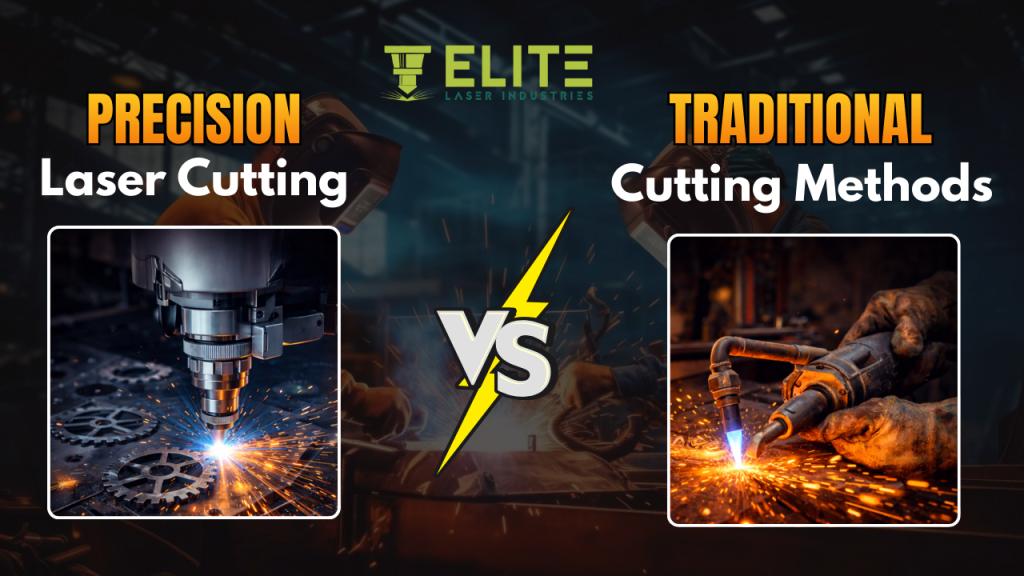
Precision laser cutting is a non-contact manufacturing process that uses a concentrated beam of light to melt or vaporize material, offering surgical tolerances as tight as 0.03mm.
Manufacturers choose this over traditional cutting methods such as mechanical sawing, shearing, or punching; because it delivers superior edge quality, faster processing for complex geometries, and significantly less material waste.
For businesses partnering with Elite Laser Industries in Carrum Downs, Victoria, this technology translates to lower production costs and the ability to execute intricate designs that traditional tools simply cannot replicate.
As the Victorian manufacturing sector moves toward “Industry 4.0” and the “Made in Victoria 2030” vision, the shift from mechanical contact to light-based precision is accelerating.
Understanding the technical differences between these methods is essential for any manufacturer looking to optimize their supply chain and meet the rigorous AS/NZS standards required for Australian industrial projects.
Understanding Precision Laser Cutting Technology
Unlike traditional methods that rely on physical force, fiber laser cutting utilizes a high-power density beam guided by CNC (Computer Numerical Control) software. Elite Laser Industries utilizes 10kW fiber laser systems that can slice through stainless steel, aluminum, and even reflective brass with incredible speed.
Key benefits of laser technology include:
- Non-Contact Processing: Since the laser beam never physically touches the metal, there is zero tool wear and minimal risk of material distortion.
- Complex Geometry Freedom: A laser can cut a company logo, intricate vents, and sharp corners in a single pass without needing a library of physical dies.
- Minimal Heat-Affected Zone (HAZ): The focused nature of the beam reduces thermal damage to the surrounding metal, preserving the metallurgical integrity of the part.
Traditional Cutting Methods: Sawing, Shearing, and Punching
Traditional cutting encompasses mechanical processes that use blades, drills, or physical punches to remove material. While these methods have served industry for decades, they often require extensive secondary finishing like grinding or deburring to remove rough edges and burrs.
CNC Punching and Mechanical Shearing
CNC punching is highly efficient for “cheese grater” pattern parts with hundreds of repetitive holes or slots. However, it requires expensive physical tooling and creates a “dead zone” where the machine’s clamps hold the sheet, leading to higher material waste compared to the tight nesting capabilities of a laser.
Mechanical Sawing and Milling
Methods like bandsawing are often used for very thick materials (> 25 mm) where lasers may struggle. However, sawing is significantly slower. Sometimes 10 to 50 times slower than a 12kW fiber laser and is limited to straight lines or simple curves.
The Showdown: Comparison of Performance Metrics
When evaluating precision laser cutting vs traditional cutting methods, manufacturers must weigh speed against accuracy and material type.
| Feature | Precision Laser Cutting | Traditional Mechanical Cutting |
| Tolerance | Tight ( 0.03 mm to 0.1 mm) | Looser (pm 0.5 mm to 1.0 mm) |
| Edge Finish | Smooth, often burr-free | Rough, often requires grinding |
| Setup Time | Near-zero (Digital file upload) | High (Tool changes/Adjustments) |
| Waste | Low (Common line nesting) | High (Physical margins required) |
| Materials | Metals, plastics, composites | Mostly limited to specific materials |
Laser vs. Plasma Cutting
In the CNC laser vs plasma cutting comparison, plasma is often the “traditional” thermal choice for heavy industrial frames. While plasma is faster for plates thicker than 30mm, it produces a wider kerf (cut width) and a larger heat-affected zone, often leaving a 4-6 degree bevel on the edge. For precision components in the medical or aerospace sectors, laser remains the undisputed champion.
Meeting Victorian Manufacturing Standards
For manufacturers in Victoria, the choice of cutting method directly impacts compliance with Australian Standards. Elite Laser Industries ensures that all fiber laser cutting services Melbourne comply with:
- AS/NZS 1554: Ensuring high-quality edge preparation for structural welding.
- AS/NZS 5131: Adhering to strict fabrication and erection requirements for steel structures.
The high precision of fiber lasers ensures that holes and slots align perfectly during on-site assembly, reducing the “rework” costs that often plague projects using less accurate traditional methods.
Why Manufacturers Partner with Elite Laser Industries
Located in the Carrum Downs industrial hub, Elite Laser Industries provides a local, agile solution for custom steel fabrication Carrum Downs. By eliminating the need for expensive physical tooling and reducing lead times from hours to minutes, they allow Melbourne businesses to stay competitive in a global market. Whether you require a single prototype or a high-volume production run, our 10kW fiber lasers deliver a level of detail and consistency that traditional mechanical tools simply cannot match.
Frequently Asked Questions
Is laser cutting more expensive than traditional mechanical cutting?
While the initial equipment investment for lasers is higher, the operational costs are often lower due to reduced labor, zero tooling costs, and minimal material waste. For custom or complex parts, laser cutting is significantly more cost-effective.
Can laser cutting handle thicker materials like traditional saws?
Modern high-powered fiber lasers, such as the 10kW systems at Elite Laser Industries, can efficiently cut steel up to 25-30 mm thick. For materials beyond this thickness, traditional methods like plasma or sawing may still be required.
Does laser cutting cause heat damage to the metal?
While laser cutting is a thermal process, the beam is so concentrated that the heat-affected zone (HAZ) is minimal compared to plasma cutting. This prevents warping and maintains the material’s strength.
Why is “non-contact” cutting an advantage for manufacturers?
Non-contact means there is no physical pressure applied to the part, which eliminates the risk of bending or distorting delicate or thin materials. It also means there are no blades to blunt, ensuring the 1,000th part is as accurate as the first.
How does laser cutting improve my project’s sustainability?
Laser cutting uses advanced nesting software to fit more parts onto a single sheet of metal. This maximizes material utilization, reduces scrap waste, and lowers the overall carbon footprint of your manufacturing process in Victoria.